+86527-88858823
sales@knt-robot.com


Writer:admin Time:2026-01-04 10:42 Browse:℃
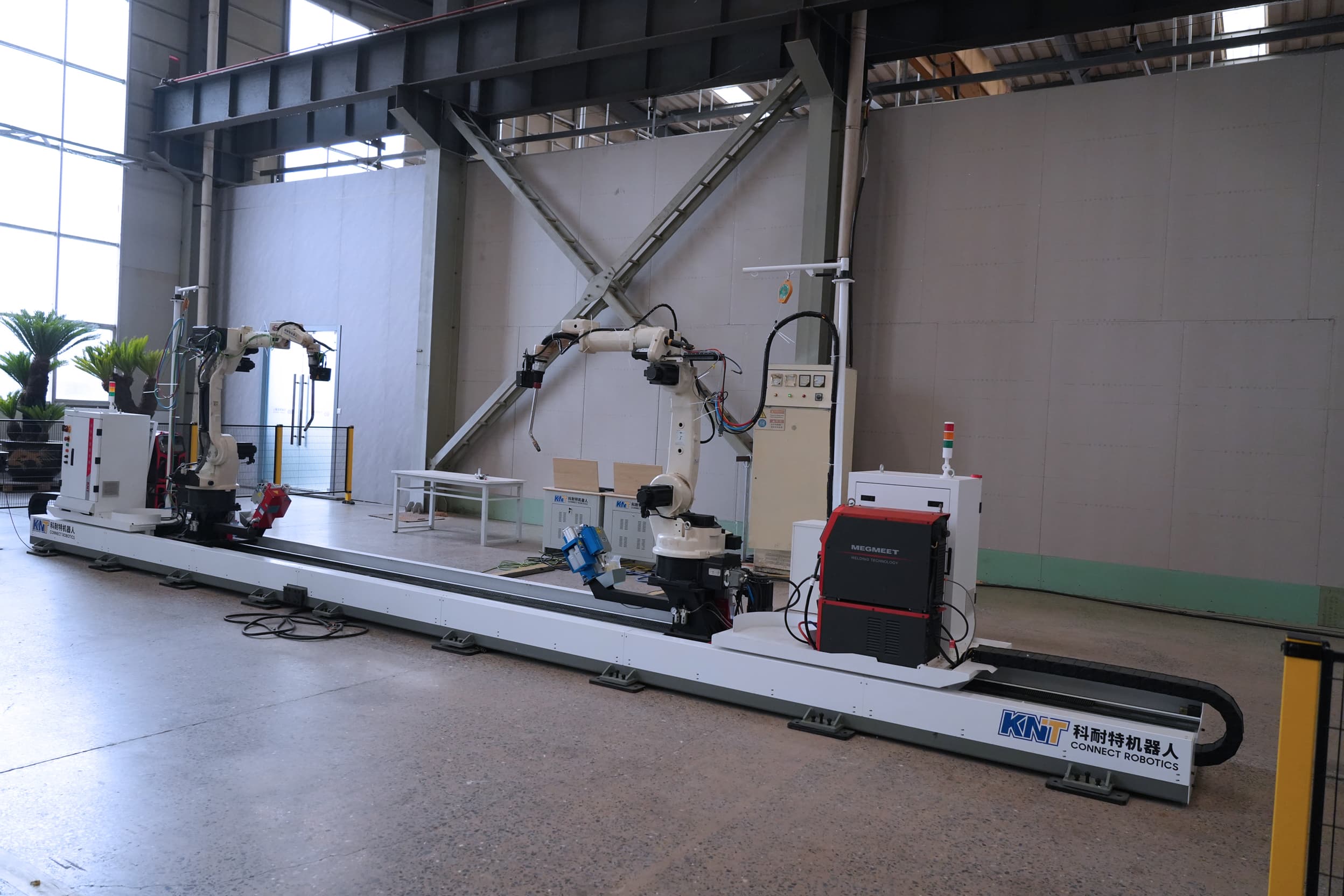
1. What is Dual-Station Welding?
Dual-station welding is a technique where two welding stations are set up on the same welding equipment. This is achieved by separately controlling the power supply, gas supply, filler material, and welding parameters for each station, allowing welding to be carried out alternately. This technology is suitable for welding processes that have higher requirements for welding efficiency, weld quality, and worker labor intensity.
2. What are the Advantages of Dual-Station Welding?
High Efficiency and Energy Saving
Dual-station welding enables welding steps to be performed in parallel, reducing welding time and improving efficiency. Additionally, by optimizing welding parameters and equipment structure, energy-saving effects can also be achieved.
Uniform Welds
Since the welding steps are performed in parallel, dual-station welding eliminates issues such as thermal deformation and residual welding stresses, ensuring that the welds are uniform, aesthetically pleasing, and possess good strength and toughness.
Flexible Specifications
Dual-station welding can adapt to various specifications of workpieces. By adjusting the equipment, welding operations can be performed on different workpieces, making the process highly versatile.
Lower Production Costs
Due to the high efficiency, high quality, and energy-saving characteristics of dual-station welding, labor costs, energy costs, material costs, and other costs in the welding process are effectively controlled and reduced, which lowers overall production costs.
Lower Labor Intensity
Dual-station welding uses robotic welding, so workers do not need to engage in monotonous, repetitive tasks for long periods, significantly reducing labor intensity.
3. Summary
Dual-station welding is a welding technology that integrates high efficiency, high quality, energy saving, flexibility, low cost, and low labor intensity. It is widely applied in modern manufacturing, improving welding efficiency and quality while reducing production costs. This is an advanced technology that is highly worth promoting and applying.
QQ: 4925567
Phone: +8618115858378
Tel: +86527-88858823
Email: sales@knt-robot.com
Addr: No. 8 Suhuang Road, Sucheng District, Suqian City, Jiangsu Province